

Deep Engineering #22: Richard D Avila on Why AI Systems Need Architecture
The prototype–production gap in AI—and the architectural discipline to close it.


SysML 2 in a Day: Hands-On MBSE Masterclass

Upgrade to SysML 2 in one focused, live online masterclass. Learn migration pitfalls, hands-on modeling, and scalable MBSE toolchains with Dr. Bruce Douglass & Dr. Brian Moberley.
When: Sat, Nov 8, 11:30 AM–2:30 PM ET (8:00–11:30 AM PT).
Early bird 30% off—code SYSTEM30.
✍️From the editor’s desk,
Welcome to the twenty-second issue of Deep Engineering.
You may already be familiar with the MIT NANDA study which found that despite $30–40 billion poured into enterprise AI, roughly 95% of organizations have seen no measurable financial impact from these projects. That means only one in twenty AI initiatives is delivering real business value. Just this week, a new Cisco study of 8,000 AI leaders similarly found that the small set of “AI Pacesetters” (about 13% of companies) are 4× more likely to turn pilots into production deployments, and 50% more likely to see measurable value from AI, compared to everyone else. Bridging this gap from a promising prototype to a reliable production AI system remains one of the biggest challenges in tech today.
So why do so many impressive AI demos fail to translate into lasting impact? How can teams bridge the gap from prototype to production to deliver lasting business value? To answer these questions, we turned to Richard D. Avila who has over two decades of experience building complex software and AI systems. He has led architecture for everything from large-scale simulations and autonomous platforms to data analytics systems, and he’s published in areas like command-and-control theory, assurance architectures, multi-agent modeling, and machine learning. Avila, along with Imran Ahmad has also co-authored the upcoming book, Architecting AI Software Systems (Packt, 2025), which will delve even deeper into how to integrate AI into traditional software architectures – complete with patterns, heuristics, and real-world case studies for making AI systems scalable, high-performance, and trustworthy.
Over the next few weeks, look out for a second feature from Avila, plus our conversation with his coauthor Imran Ahmad—two issues that dig into patterns, gates, and failure-mode thinking for AI in production. And when Architecting AI Software Systems is out, we plan to share an exclusive excerpt from the book for Deep Engineering readers.
Ship Faster with DevStats: Spot bottlenecks early, keep engineers in flow, and deliver up to 30% faster.

🧠Expert Insight
From Prototype to Production: Why AI Systems Need Architecture Discipline by Richard D Avila
How architecture makes model- and data-driven systems production-ready
The GenAI Divide: STATE OF AI IN BUSINESS 2025 study by MIT NANDA surveyed several hundred executives on AI initiatives and found that only 5% of AI projects demonstrated lasting value. AI initiatives fail to make it to production because teams don’t define how the AI will deliver value or account for the complex realities of a production environment. In this article, we discuss specific gates and actions that, if followed, will mitigate the risk of a failed prototype-to-production deployment. A very short exemplar or mini-case study is included.
Why call out AI systems? Unlike traditional software, AI systems are model- and data-driven: behavior depends on training data, live inputs, and evaluation metrics. Architecture is how we make that behavior predictable and operable in production.
Why architecture work matters
Architecture makes prototypes survivable in production by forcing end-to-end thinking about data reality, key non-functional constraints, stakeholder trust, and the documentation that turns design into testable behavior.
Data reality: The key driver in any AI system is the quality of the data used for training and inference. Data engineering is often not done well or not done with a large enough aperture to appreciate the full end-to-end system. For example: does the prototype assume well-formatted or highly structured data that is not possible in production? Did the prototype suppose that data into the system was ordered but, in a production environment, that is not the case? Was the system overly reliant on a technology that cannot scale to expected production data rates? And so on.
Partitioning and organization: Software architecture involves design decisions about partitioning and organization. An analysis of the software components of the prototype can identify where choke points may occur, how interfaces into and out of the prototype were handled, and where a component may require more design work in a production environment.
Non-functional requirements: A robust architecture captures and understands the key non-functional requirements at play in the production environment. For example, will the new AI functionality impact availability requirements that, if not met, would result in a critical error? Does the new model with higher production data rates impact performance requirements that have cascading effects?
Trust tolerance: Robust architecting should illuminate the trust tolerance and decision making of key stakeholders. For example, does a single off-nominal inference or decision result in a loss of confidence or outright hostility to the new AI functionality? As part of a conceptual design, guard rails or off ramps can be put into the design so there is a sort of “no-harm” guarantee that may cause consternation but not a loss of confidence.
Documentation to test: The documentation of a conceptual design can aid in defining and illuminating test cases and scenarios that the prototype must satisfy in a production environment.
A fair criticism—and the response
It’s reasonable to say that architecting adds “document-centric” work that slows delivery. But the MIT statistic exists for a reason: no amount of heroic coding fixes a flawed architecture. Water doesn’t flow uphill; a bad architecture produces a bad system. Agile methods work best when a stable architectural frame guides rapid prototyping, integration, and demos. Productive engineering isn’t only writing code—it’s also designing systems that can survive production.
Architecting is critical in guiding engineering decisions and priorities. This is done by laying out the conceptual design of the end system. One of the first drivers of architecture is to have a solid conceptual design that informs prototyping. That same design later anchors the pass/fail criteria that we can categorize into gates.
Five production-readiness gates (with actions)
There are five gates or decision buckets—pass/fail outcomes we must clear before go-live.
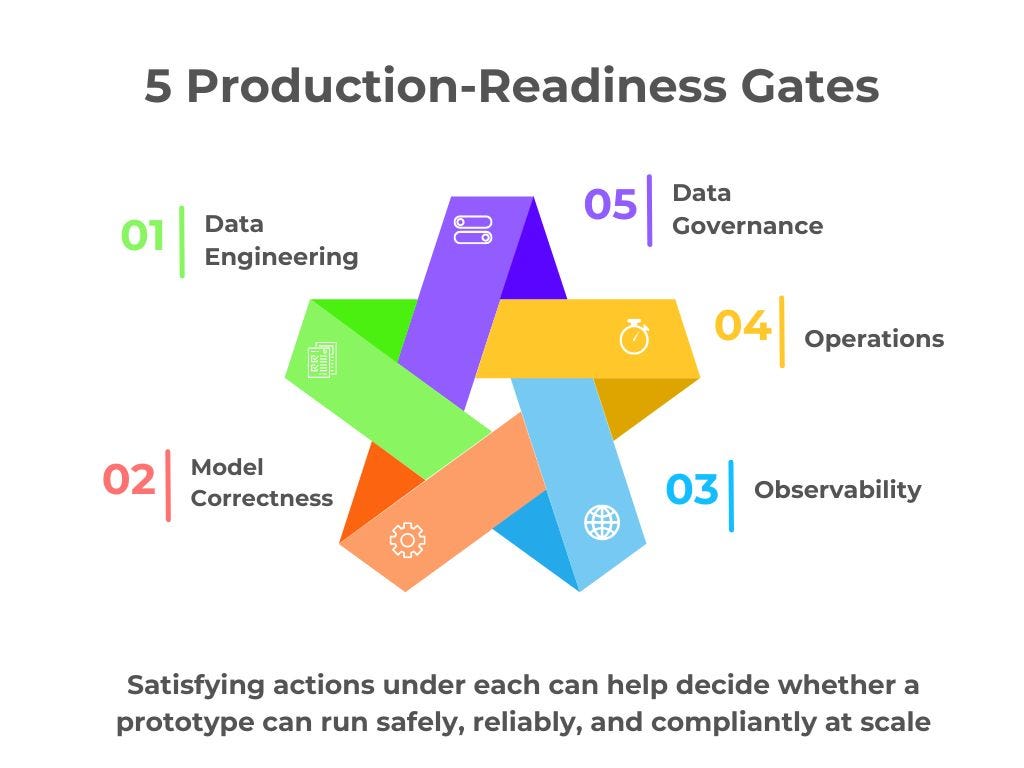
Note: the following actions are not exhaustive.
1) Data Engineering (AI inputs and contracts)
Analysis: Confirm that production inputs and interfaces match what the model expects—data rates, formats, fields, identifiers, consistency, and summary statistics.
Ingest testing: Exercise the pipeline with current production data and verify ingest correctness and throughput.
Resilience checks: Prove the prototype tolerates malformed records, off-nominal flows, and misformatted streams without cascading failures.
2) Model Correctness (does the model still earn its keep?)
Ongoing relevance: Verify the model still solves a real user problem; retire it if it no longer does.
Performance on live data: Re-evaluate with current production samples; confirm metrics such as AUC, accuracy, and false positive rate meet or exceed targets.
Execution time: Show end-to-end model latency remains within bounds required by downstream consumers and users.
3) Observability (for data pipelines and model behavior)
Data flow telemetry: Logging and monitors for inputs, transformations, and handoffs.
Model execution telemetry: Traces, metrics, and logs for inference paths and failure modes.
Acceptance bounds: Document thresholds, alert rules, and expected distributions for observability metrics.
4) Operations (release and recovery for AI pipelines)
Canaries: Implement canary or shadow releases to surface pipeline issues before full rollout.
Time budgets: Define and monitor time bounds for the full pipeline and each critical stage.
Update paths: Document steps for model refresh, rollback, and disentanglement from production if needed.
5) Data Governance (quality, compliance, ethics)
Quality audit: Run a data quality review on the latest production datasets.
Compliance docs: Prepare artifacts to satisfy regulatory, security, and privacy requirements.
Ethical filters: Enforce policy-aligned filtering and access controls.
In addition to these gates, the key non-functional requirements for the system need to be monitored, with action plans to ensure they are met—for example, time budgets across the system via specialized logging and canary deployments.
The gates define what must be true to go live; let us go a step further and look at the rubric that translates the actions into concrete checks and artifacts that prove each gate is passed.
Rubric for pre-deployment checks
Here is a rubric you can use as a go/no-go gate: confirm business relevance, data contracts, operational readiness (including rollback), on-call coverage and monitoring, and model quality against explicit SLOs before promoting any prototype to production.
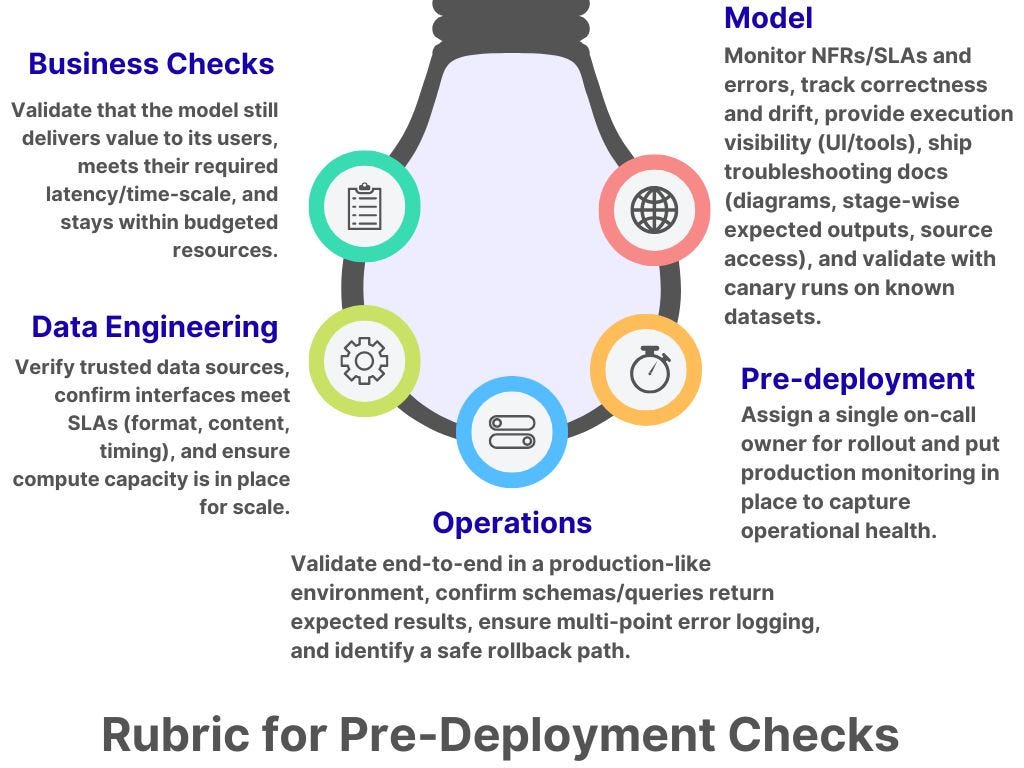
This rubric is the evidence and checks that prove each gate is passed and that you can go live.
Business Checks
Is the model output still relevant to intended users?
Is the prototype operating at time scales relevant to users?
Is the prototype still within budget and resource limits?
Data Engineering
Verify data sources.
Verify interfaces still meet service-level agreements (format, content, time budgets).
Confirm computational resources for scale are in place.
Operations
Verify the prototype in a pre-production environment or a simulation that mimics true production.
Confirm datastore schemas and queries execute correctly and produce expected results.
Ensure error logging exists at multiple points with sufficient detail for troubleshooting.
Identify a rollback procedure to take the model offline if needed.
Pre-deployment
Identify a developer or staff resource to support rollout and address issues promptly.
Ensure monitoring is in place to capture operations.
Model
Monitor non-functional requirements, SLAs, and errors.
Track correctness metrics (AUC, accuracy) and model drift.
Provide a user interface (or tools) to visualize execution.
Supply guides/documentation for troubleshooting, architecture diagrams, expected outputs at each stage, and accessible source code.
Use canaries with injected known datasets for monitoring.
Mini case study
To understand how the 5 gates and the rubric work in cohesion, let us take the example of a new application that recommends technical articles to an engineering audience. Before launch, the team decides to apply actions under each of the 5 gates and the Pre-deployment checks reveal the following:
Data & Schema
Since training began, an extra tag field was added; the date format also changed, breaking metadata parsing.
The datastore schema drifted: a key field changed, requiring interface updates.
Model Correctness: On current production data, AUC dropped below training thresholds; investigation showed an over-represented training subset.
Observability: Logging failed; output and processed-file logs couldn’t be written due to permission issues.
Operations & Release: The team planned to launch at peak traffic with no rollback procedure.
Governance: A compliance check found personal information was being collected and shouldn’t have been.
As a result, a failed release is prevented.
For AI systems, some architecting during prototyping helps cross the chasm from an impressive demonstration to a production system that delivers true value and positive business outcomes.
If you found this article insightful, Richard D Avila and Imran Ahmad’s forthcoming book, Architecting AI Software Systems extends the same ideas with a structured approach to integrating AI into traditional architectures—covering how inference and decision-making shape design, using architectural models to ensure cohesion, mitigating risks like underperformance and cost overruns, and applying patterns and heuristics for scalable, high-performance systems—anchored by real-world case studies, hands-on exercises, and a complete example of an AI-enabled system for architects, engineering leaders, and AI/ML practitioners.

Join Snyk on October 22, 2025 at DevSecCon25 - Securing the Shift to AI Native
Join this one-day event to hear from leading AI and security experts from Qodo, Ragie.ai, Casco, Arcade.dev, and more!
🛠️Tool of the Week
Evidently (open-source ML/LLM observability)
Evidently is an open-source Python framework to evaluate, test, and monitor AI systems—covering classical ML and LLM/RAG—from offline experiments to live, production monitoring; it ships frequent releases (latest v0.7.15 on Oct 14, 2025) and is used to monitor models in production across industries.
Evaluation & testing: 100+ metrics for data and model quality, LLM/RAG evals (e.g., context relevance, generation quality), and reproducible reports you can version and review before go-live.
Production monitoring: Batch jobs and pipelines to track data drift, model performance, latency/SLOs, and acceptance bounds with dashboards and alerts for running systems.
Easy integration: Python-first; works with existing logging/metrics stacks and CI/CD so you can add canaries, regression checks, and rollbacks into release workflows.
📎Tech Briefs
Cisco AI Readiness Index 2025: Cisco identifies a small cohort of “Pacesetters” (~13% of firms) consistently turning pilots into measurable value across strategy, data, infrastructure, talent, governance, and culture.
Air Street Capital State of AI Report 2025: A comprehensive annual review (research, industry, safety, policy) with a downloadable deck and key takeaways on the rise of reasoning models, infrastructure constraints, and commercial traction. Here are the key insights:
OpenAI and Broadcom announce strategic collaboration to deploy 10 gigawatts of OpenAI-designed AI accelerators: This will lock in and massively scale dedicated compute—via custom, non-Nvidia accelerators at ~10 GW—so OpenAI can cut cost/latency, improve energy efficiency, and secure a reliable supply chain for training and serving next-gen models.
AI investment boom shielding US from sharp slowdown, says IMF: The IMF nudged its global growth outlook up slightly while still flagging a 2025–26 slowdown; it says more of the tariff costs will pass through to U.S. consumers, even as AI-driven capex props up near-term U.S. growth; it pegs U.S. GDP at ~2.0% in 2025 and 2.1% in 2026; and it warns an AI investment boom could see a dot-com-style shakeout.
That’s all for today. Thank you for reading this issue of Deep Engineering. We’re just getting started, and your feedback will help shape what comes next. Do take a moment to fill out this short survey we run monthly—as a thank-you, we’ll add one Packt credit to your account, redeemable for any book of your choice.
We’ll be back next week with more expert-led content.
Stay awesome,
Divya Anne Selvaraj
Editor-in-Chief, Deep Engineering
If your company is interested in reaching an audience of developers, software engineers, and tech decision makers, you may want to advertise with us.
 | A guest post by
|