

Deep Engineering #20: When Mapping Becomes the Algorithm with Elías F. Combarro & Samuel González-Castillo
Think quantum is still theoretical? Now see this (on real hardware).


Join us on October 22, 2025 at DevSecCon25 - Securing the Shift to AI Native

This one-day event brings together AI, App, & Security pros to discuss securing the shift to AI Native SDLCs via DevSecOps.
The summit features speakers like Nnenna Ndukwe & Bob Remeika, plus an AI Lab with hands-on workshops, AI Security Research, and a Product Track!
✍️From the editor’s desk,
Welcome to the twentieth issue of Deep Engineering.
IBM says HSBC used a hybrid quantum–classical workflow on its Heron hardware and achieved up to 34% better accuracy at predicting whether a corporate-bond trade would fill. If you are still on the fence about taking quantum computing seriously: this outcome means a real bank ran a bounded experiment (one prediction task, one metric) where a small quantum circuit—compiled to a specific device and run alongside classical code— moved the needle on a business outcome.
And we feel, this is a really good time to return to our very extensive interview with Prof. Elías F. Combarro for today’s feature. In Issue #10 we focused on how quantum programs are designed and debugged on unfinished machines; this time we use different parts of the same conversation to explain the mechanics that make a result like HSBC’s possible: mapping and transpilation that alter circuit behavior, measurements that yield distributions (not single answers), and the role of logical vs physical qubits when circuits get long.
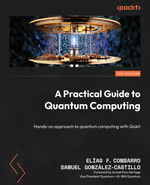
Combarro is a full professor of Computer Science at the University of Oviedo, former advisor to CERN’s Quantum Technology Initiative, and co-author of A Practical Guide to Quantum Computing (Packt, 2025) along with Samuel González-Castillo. González-Castillo is a mathematics researcher at the University of Oviedo focused on algebraic methods in quantum computing and a former CERN openlab contributor (quantum-simulator benchmarking, 2021). If you want the deeper mechanics, we’ve included the complete Chapter 14 — Quantum Error Correction and Fault Tolerance from their new book A Practical Guide to Quantum Computing.
Let’s get started!
Packt Deep Engineering is proud to partner with PyCon Sweden 2025 Oct. 30th – 31st, 2025
What the Transpiler Can’t Hide with Prof. Elias F. Combarro
Hardware-aware code, probabilistic outcomes, and why reproducibility is different in quantum software.
Quantum transpilers are essential, but they cannot abstract away device topology, calibration drift, or the fact that measurement changes the system you’re trying to observe. In the parts of our conversation with Prof. Elías F. Combarro that didn’t make Issue #10, a consistent message was: trustworthy quantum results depend on knowing how circuits map to devices, how measurement changes what you can observe, and how to prove intent on simulators before touching hardware.
If you missed it:

As Combarro says:
“The concept of transpiling or compiling is quite similar to classical programming. In classical computing, you write code in a high-level language like C or Java, and then it gets compiled into machine code. In quantum computing, it’s the same idea: your code—written, say, in Qiskit—is translated into a sequence of low-level quantum operations that can be executed on hardware.
However, there are important differences.”
Those differences show up the moment a source circuit meets a real backend.
First, quantum “high-level” languages are still very low-level by classical standards. You don’t have loops, branches, or complex data structures. So the abstraction gap is smaller.
Second, unlike classical compilers, quantum transpilers can’t completely shield you from hardware details. In classical computing, you usually don’t have to think about the processor’s internal wiring. But in quantum computing, that kind of detail really matters. Not all qubits in a quantum computer are connected to each other. So if you want to apply a gate to two distant qubits, the transpiler has to insert extra operations to move data around—introducing noise and increasing circuit depth.
Topology and calibration matter day to day, not just in benchmarks.
“As a quantum developer, you need to know something about the machine you’re targeting… The transpiler will find a way to bring them together using swap gates—but that adds overhead and error risk… even the quality of individual qubits varies.”
That reality shapes workflow. You set intent where the math is exact, then approach hardware in controlled steps.
“To untangle that, you start by running your code on a classical simulator. These simulators are deterministic and noise-free—they give you the exact mathematical result of the circuit, assuming perfect qubits.”
Simulators set the target distribution; they also set scale limits.
“For example, to simulate 38 qubits, we needed 8 terabytes of RAM. To simulate 39, we’d need 16 terabytes.”
Between a perfect statevector and a noisy device, developers still need observability without destroying state. During development, classical techniques are still available—up to a point.
“Since quantum programs are often run on classical simulators during development, you can use standard debugging tools—like breakpoints, inspection, or logging… One of the most useful techniques is inspecting the state vector at different points in the circuit.”
On hardware, “reproducible” means something narrower than in classical systems.
“Quantum computations are inherently probabilistic, so you can’t reproduce the exact same measurement result every time. What you can do is ensure a high probability of success.”
The measurement model is part of the design space. Even when mid-circuit measurement is possible, theory keeps you honest about what it buys you.
“There’s a theorem in quantum computing that says if you want to measure something in the middle of a circuit, you can simulate that effect by deferring the measurement to the end and adjusting the circuit accordingly.”
Error correction reframes resources and observability. The unit you program toward becomes an encoded abstraction.
“Instead of storing information in a single qubit, you spread it across many qubits… The individual ones are called physical qubits, and the combined, encoded unit is a logical qubit.”
You still don’t get to peek at the data itself.
“You can’t measure a qubit without collapsing its state. So quantum error correction uses partial measurements—what we call syndrome measurements—that only reveal limited information about what kind of error may have occurred, without disturbing the actual quantum information.”
Until those encodings are routine, depth and connectivity set practical limits—even for canonical algorithms.
“These algorithms were designed for ideal quantum computers—machines with no noise and perfect gates… The longer the circuit, the more likely it is that errors will accumulate… [and] connectivity… makes it more error-prone.”
At cryptographic scales, the gap is concrete.
“To get 2,000 or more reliable logical qubits, you’d need many times that number in physical qubits—perhaps hundreds of thousands. That’s far beyond current capabilities.”
Toolchains are improving, but sharp edges remain.
“Quantum software libraries evolve very quickly… That situation has improved a lot… When Qiskit 2.0 came out, we only had to make a few changes.”
And sometimes the rough edge is small but consequential.
“While writing this book, we discovered that the name of the result variable in Qiskit changes depending on whether you declare measurements at the beginning or at the end of a circuit. That wasn’t documented, and it took us a while to figure it out. So we included a clear explanation in the book to save others the trouble.”
Putting these pieces together, a working picture emerges from Combarro’s remarks.
💡Key takeaways
Mapping shapes behavior: Layout, inserted swaps, and two-qubit counts change the circuit you thought you wrote and the error surface it traverses.
Simulation establishes intent: Prove the ideal distribution first; then introduce noise models; then touch devices.
Results are distributions: Outcomes are probabilistic by design; reporting means histograms, shots, and success probabilities, not single runs.
Encodings change the unit of work: Logical qubits, built from many physical qubits and syndrome measurements, define how long circuits become viable.
None of this is a reason to pause. It’s a reason to describe work in terms that match the physics and the compilers we have. As Combarro says about compilation:
“It’s the same idea… but the abstraction gap is smaller.”
That smaller gap is where serious quantum software lives today: close to the device graph, explicit about measurement, anchored by simulation, and clear about what changed after transpilation.
To see how these constraints become engineering practice, download and take a look at Chapter 14 — Quantum Error Correction and Fault Tolerance in Combarro’s book, where logical qubits, syndrome measurements, and fault-tolerant gates formalize the path to running long circuits reliably.
🧠Expert Insight
The complete “Chapter 14: Quantum Error Correction and Fault Tolerance” from the book A Practical Guide to Quantum Computing by Elías F. Combarro and Samuel González-Castillo (Packt, 2025)
Our complete conversation with Elias F. Combarro
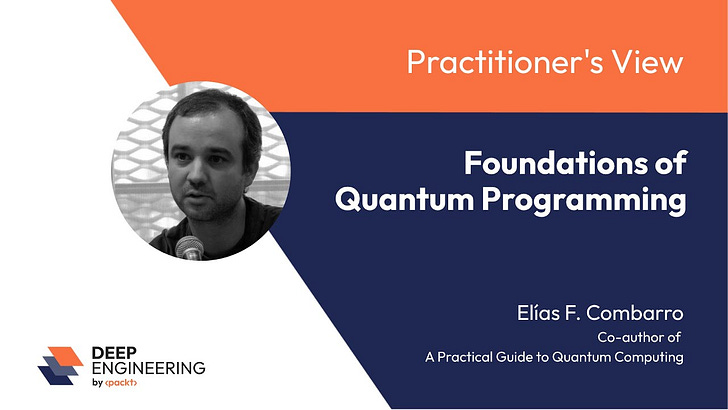
Foundations of Quantum Programming: A Conversation with Prof. Elías F. Combarro
·From quantum search and error correction to tooling constraints and software reproducibility, programming for quantum computers is unlike anything in classical systems. In this conversation, we speak with Professor Elías F. Combarro—co-author of A Practical Guide to Quantum Computing
Sponsored:
Advance your technical career with actionable, practical solutions at AWS re:Invent 2025 | Las Vegas

Transform your skills at AWS re:Invent 2025. Master new AWS services, join immersive workshops, and network with top cloud innovators at AWS re:Invent 2025. As a re:Invent attendee, you’ll receive 50% discount code towards any AWS Certification exam. Our 2025 event catalog is now available!
🛠️Tool of the Week
PennyLane (Xanadu, open-source)
A cross-platform Python framework for quantum computing and hybrid ML with differentiable programming and multi-backend support—well-suited to circuit mapping, depth control, and measurement workflows.
Current usage: Integrates directly with Amazon Braket via the official PennyLane–Braket plugin, allowing runs on managed QPUs and simulators. Also used in recent academic collaborations (e.g., Yale Quantum Institute) surfaced by the maintainers.
Actively updated: v0.42 released July 15, 2025; maintenance updates v0.42.2 on Aug 11, 2025 (and ongoing 0.42.x notes).
Project status: Mature, widely used research tool maintained by Xanadu; open source under permissive licensing.
📎Tech Briefs
IBM × HSBC: early signal in quantum finance: HSBC reports up to 34% improvement in predicting bond-trade completion using hybrid quantum-classical methods on IBM Heron processors.
IBM outlines software for quantum-centric supercomputing: Details open-source Slurm plugins and a Quantum Resource Management Interface (QRMI), and notes the first university QCSC environment at RPI.
AWS × Chugai: quantum-inspired docking: Describes constraint programming and QUBO-based approaches for cyclic peptide–protein docking.
IonQ advances quantum networking: Demonstrates frequency conversion from trapped-ion photon wavelengths to telecom bands, a step toward long-distance quantum interconnects.
Nature: neutral-atom ‘conveyor belt’: A neutral-atom conveyor-belt array reported in Nature points to scalable qubit transport and layout for larger systems.
That’s all for today. Thank you for reading this issue of Deep Engineering. We’re just getting started, and your feedback will help shape what comes next. Do take a moment to fill out this short survey we run monthly—as a thank-you, we’ll add one Packt credit to your account, redeemable for any book of your choice.
We’ll be back next week with more expert-led content.
Stay awesome,
Divya Anne Selvaraj
Editor-in-Chief, Deep Engineering
If your company is interested in reaching an audience of developers, software engineers, and tech decision makers, you may want to advertise with us.
 | A guest post by
|
|