

Benchmarks Are Making AI Coding Look Safer Than It Is
Passing tests is not proof the code is safe or maintainable.

Most technical leaders are optimizing for speed. AI agents now generate code fast enough to reshape how teams ship software. So teams contending with shorter deadlines and shrinking budgets are integrating them into delivery pipelines to increase velocity.
If you are an engineering leader, you have likely seen the SWE-bench leaderboard. It is the current industry standard for ranking AI coding agents. It scores agents based on whether they can produce a patch that passes a test suite. If it does, the agent gets a gold star.
But there is a deeper and often overlooked problem that creates a blind spot for enterprise teams.
Most teams treat these scores like a proxy for real engineering readiness. Speed is not the same as quality, but true velocity is speed plus quality. And passing tests is not the same as writing safe, maintainable code. This then shows up later as security debt, brittle systems, and review fatigue.
The Pass/Fail Trap
Benchmarks like SWE-bench are designed to test code generation rather than code quality. They ask if the agent can generate a solution that satisfies the immediate requirement.
They do not ask if the code is maintainable or if it introduces a hidden security vulnerability. They also ignore whether the new code breaks the architectural pattern of the rest of the application.
Itamar Friedman is the CEO and co-founder of Qodo, the AI Code review platform, says this creates a false sense of security for technical leaders.
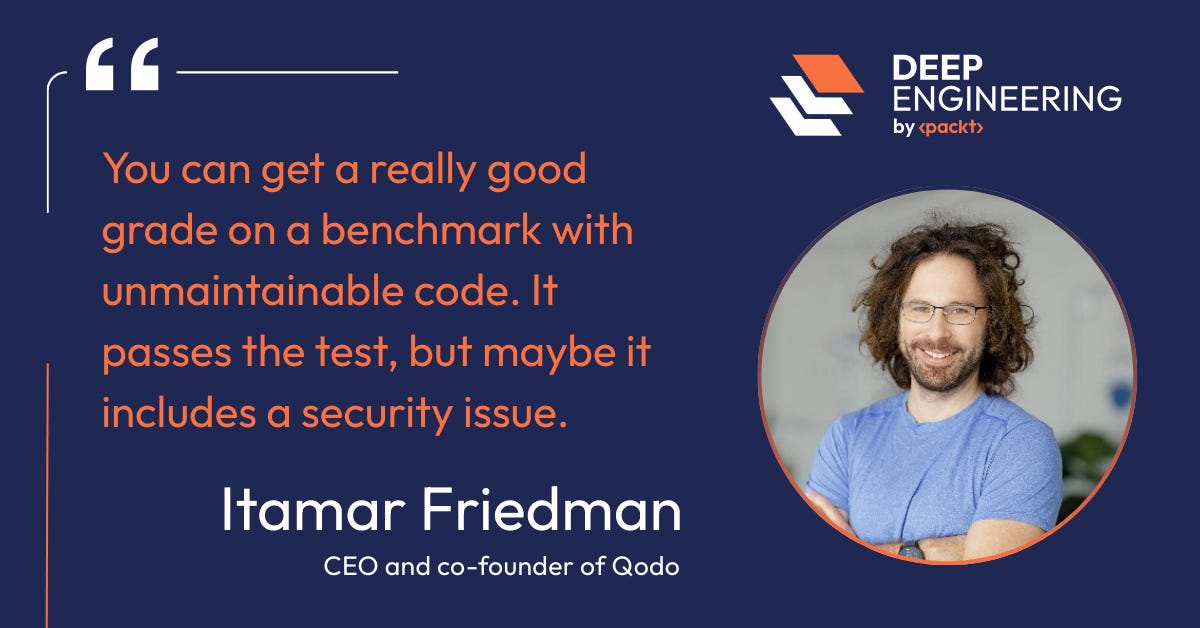
“SWE-bench is a benchmark that is meant mostly to check code generation capabilities. You can get a really good grade with quite shitty code. It will pass because it implements the requirements and passes the test. But maybe the code is not maintainable. Maybe it includes a security issue.”
The Illusion of Speed
In the past, humans wrote code slowly and other humans reviewed it just as slowly. Now that AI agents are writing code at lightning speed, developers are opening two to five times more Pull Requests than they did a year ago.
This creates a phenomenon called quality rot. Even if AI generates code that is as good as a human’s, generating ten times more of it means you also generate ten times more bugs.
Friedman argues that relying on a “generation benchmark” to solve this is dangerous. He compares software development to accounting to show why the roles must be separate.
“You have bookkeeping and you have auditing. Ideally, you have two different people that are experts. One is doing the bookkeeping and the other is doing the auditing to verify the quality. Using the same agent to do both tasks is counterproductive.”
The Hidden Risk of Review Fatigue
When AI agents generate thousands of lines of code in minutes, human reviewers naturally get overwhelmed. They start skimming the code and often trust the AI simply because the test suite passed.
This is exactly where bugs slip in. A generalist model like GPT-5 might fix a logic bug but accidentally hardcode a credential or use a deprecated library.
If you rely on the same model to review the code it just wrote, you are essentially asking the fox to guard the hen house. A generalist model might be creative enough to solve the problem, but it lacks the rigid structure needed to audit safety.
What You Should Do
You need to stop obsessing over which model has the highest SWE-bench score and instead build a system of checks for your AI.
First, do not trust the generalist model to police itself. You should use specialized agents where one agent writes the code and a completely different agent reviews it against a strict policy.
Second, you should measure the number of valid bugs your AI catches in PRs rather than just how many PRs it opens.
Finally, you need to treat your AI pipeline like a government rather than a single employee. Friedman emphasizes that a single agent is never enough to ensure enterprise trust.
“You need a system. A system like a country. There are policies, rules, and a police.”
The future is not about faster coding but about smarter reviewing.