

Agentic AI Is Redefining Edge Infrastructure
Agents can't wait. Neither can your infrastructure.

Artificial intelligence is entering a new phase with agentic AI, where autonomous systems perceive, decide, act, and learn without constant human oversight, operating independently across distributed environments while collaborating with other agents in real time.
This shift from centralized AI models to distributed, autonomous agents requires a fundamental rethinking of WAN infrastructure architecture. Previous AI patterns such as centralized training clusters, cloud-based inference, and hub-and-spoke data flows are inadequate for agentic systems that must operate at the edge with speed, autonomy, and resilience.
And in these environments, the WAN is no longer just a means of connecting branch sites to core data centers. It becomes the essential fabric enabling edge agents to synchronize data, share insights, and coordinate actions, making WAN performance, availability, and adaptability critical to agentic AI effectiveness.
Distributed intelligence is edge-centric
Lee Peterson, VP of Secure WAN Product Management at Cisco, explains where the pressure lands first. Edge environments routinely face unpredictable connectivity, and agents operating in those conditions cannot wait for centralized systems to respond.
Peterson points to concrete scenarios where this plays out, from autonomous vehicle navigation systems to intelligent manufacturing floors to retail environments where AI agents manage inventory, pricing, and customer experience simultaneously. In each of these cases, he reasons, the decisions that matter most are the ones that have to be made in milliseconds, based on local conditions, often where connectivity to centralized systems is intermittent or constrained.
But the connectivity assumption is where many organizations get it wrong. Peterson recommends designing for intermittent or constrained WAN conditions rather than treating reliable connectivity as a given, and ensuring real-time path selection for critical systems such as point-of-sale, inventory sync, and IoT devices so that agents can perform automatic remediation during WAN degradation without waiting on human intervention.
Unlike traditional AI models operating on data in controlled environments, he notes, agentic systems exist in the physical world where latency is measured in milliseconds and decisions have immediate consequences. Sending data hundreds of miles to a cloud data center for processing, Peterson argues, is structurally incompatible with the real-time autonomy these systems require, because the agent must process information, evaluate options, and act locally, right where the action is happening.
And the scale of coordination compounds this further. A smart city deployment might involve thousands of agents managing traffic flow, energy distribution, and public safety simultaneously, and Peterson underscores that these agents need to share insights and coordinate actions even when network connectivity degrades.
Organizations that continue to architect around centralized control will find their agentic deployments constrained at precisely the moments that matter most, because this distributed intelligence model is inherently edge-centric and the infrastructure needs to reflect that from the start.
Compute at the edge: the foundation of agent autonomy
Agentic AI requires compute resources co-located with data sources and decision points, which means deploying high-performance processing across thousands of distributed locations including retail, manufacturing, healthcare, and transportation.
The workload requirements are diverse and demanding, covering agents performing rapid inference on streaming data, conducting local model fine-tuning based on environmental feedback, and coordinating with peer agents across locations in real time. In retail, Peterson notes, this might translate to supporting smart shelves, computer-vision inventory systems, digital signage, loss-prevention analytics, and customer-flow optimization directly at each store location, which is a significant compute footprint by any measure.
But powerful edge compute alone cannot deliver the full potential of agentic AI, and Peterson is direct about why. Without equally sophisticated networking, autonomous agents remain isolated, unable to coordinate with peers, synchronize insights, or maintain collective intelligence across distributed environments. The two investments have to be planned together, not sequenced, because the value of edge compute depends almost entirely on the quality of the network that connects it.
Networking at the edge: the nervous system of distributed intelligence
Just as compute provides the processing foundation for autonomous decisions, networking forms the connective tissue enabling multi-agent coordination. Peterson is specific about what agentic AI requires from it. Low-latency communication between distributed agents, efficient data synchronization, security across untrusted environments, and effective network partitioning are not aspirational requirements but operational ones, and the gap between meeting them and not meeting them is the gap between a functioning agentic system and an isolated one.
Consider a manufacturing environment where dozens of AI agents coordinate production, where vision systems inspect components, robots adjust operations in real time, and predictive maintenance agents analyze telemetry from across the floor. Peterson uses this kind of environment to ground the networking argument, because these agents must communicate with millisecond latency and maintain coordinated operation even if connectivity to central systems is temporarily lost. His architectural recommendation is specific in that high-performance networking should be integrated directly into edge compute infrastructure to enable agent-to-agent communication with low latency and high bandwidth, rather than routing every interaction through distant aggregation points, because that approach where networking and compute are designed together is what makes real-time coordination possible.
On security, Peterson is equally precise and equally unambiguous. These systems require cryptographic identity for every agent, encrypted communication, hardware-based roots of trust, and zero-trust architectures designed into both layers from the ground up, ensuring the integrity of autonomous decisions affecting physical systems and human safety in critical infrastructures such as healthcare and transportation. Not as hardening added after deployment, but as a design constraint from day one.
The convergence of compute and networking at the edge
Peterson frames this moment as an inflection point for enterprise infrastructure strategy, and the practical implication is straightforward even if the work is not. Organizations cannot simply extend cloud architectures to edge locations and expect agentic systems to thrive, because the autonomous, distributed, real-time nature of these systems demands infrastructure where compute and networking are designed together to support local intelligence, agent coordination, and secure operation across thousands of diverse locations.
And there is a visibility dimension that Peterson adds, one that often gets missed in these conversations. As organizations deploy distributed AI agents across vast, heterogeneous environments, continuous visibility into WAN performance, network health, and application performance at each edge location becomes indispensable, because without it, blind spots undermine the autonomy and resilience that agentic AI requires and teams lose the ability to detect issues proactively, optimize operations, and assure reliable service delivery before degradation affects outcomes.
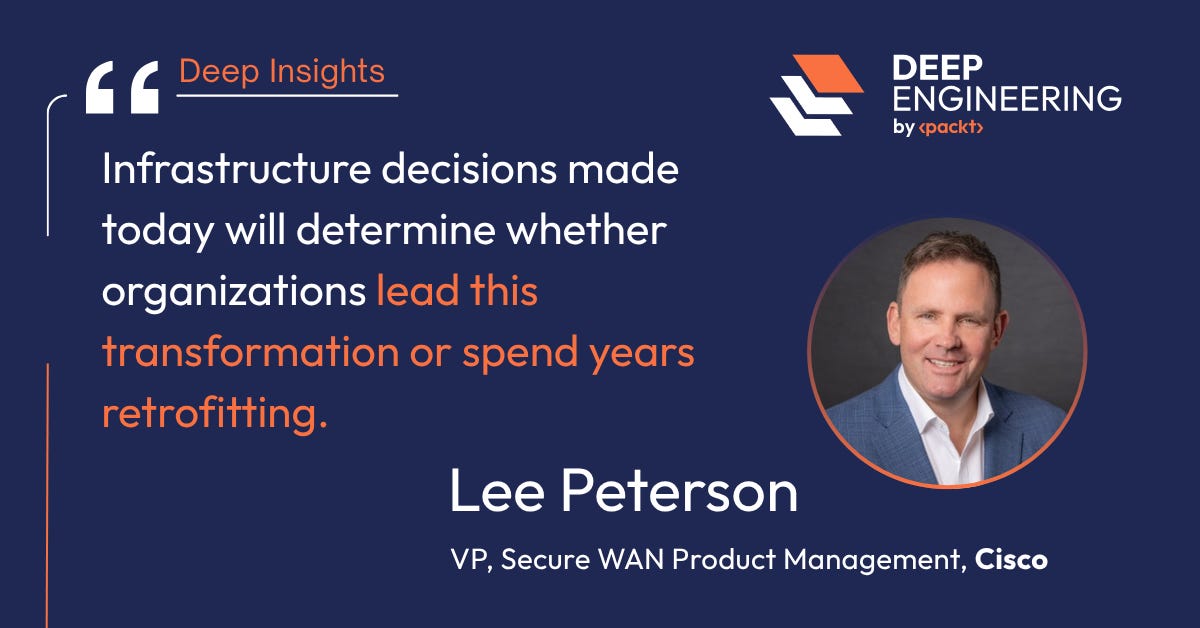
Of the choices organizations face right now, Peterson is clear about which ones carry the most weight. Infrastructure decisions made today will determine whether organizations lead this transformation or spend years retrofitting, and the convergence of compute and networking at the edge, he concludes, is the essential foundation upon which the next generation of autonomous, intelligent systems will be built.